

From Seed to Planting: The bottleneck that threatens the restoration of the Atlantic Forest.
From Seed to Planting: The bottleneck that threatens the restoration of the Atlantic Forest.
From Seed to Planting: The bottleneck that threatens the restoration of the Atlantic Forest.
Miscommunication between those who produce seedlings and those who plant them means that only 20% of the nurseries' capacity actually reaches the field; Copaiba proposes planning actions to optimize the sector.
Ecological restoration is one of the best tools to combat the effects of climate change, conserve water resources, protect biodiversity, and ensure our survival on the planet. Copaíb Environmental AssociationThe, Like many other institutions, it works with a focus on the mission of conserving, restoring, and protecting the Atlantic Forest, and has realized over the years that one of the main problems is not the lack of land, absence of technologies, or lack of resources, but rather the failure of planning between seedling producers, who are the base of the restoration network, and planters, who are at the top of this network.
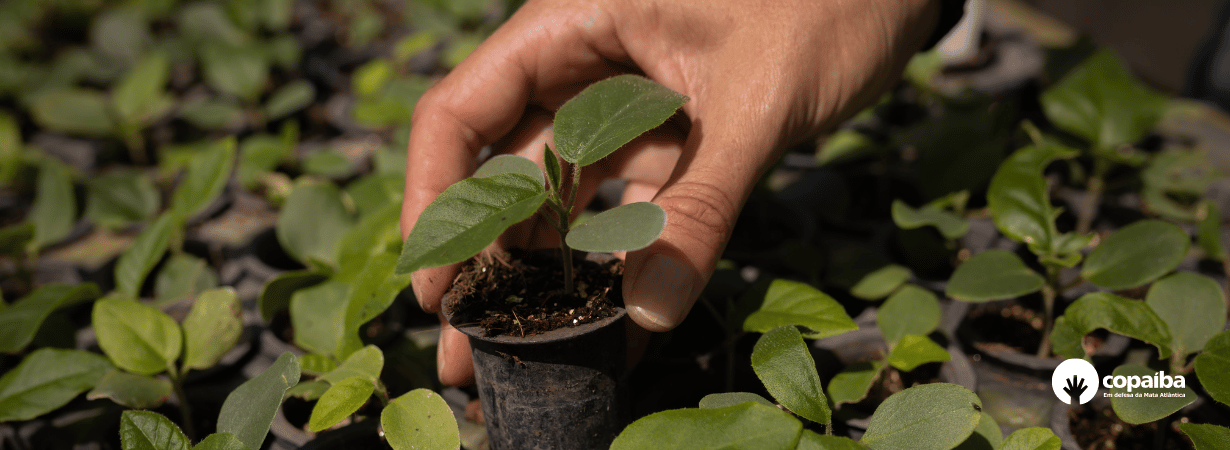
THE Copaiba She experiences this reality from a privileged perspective, as she acts as a producer of native seedlings in her nursery and as an executor of planting projects in the field. This involvement at both ends of the restoration network allows her to... Copaiba To understand the bottleneck between seedling production and actual planting.
According to Flávia Balderi, executive secretary of Copaíba, and responsible for Copaiba Nursery, Nurseries are experiencing great difficulty in planning seedling production due to a lack of alignment with potential buyers. "We need to raise awareness among buyers so that they present their demands to nurseries with more advance notice. It's important to know how many seedlings we will have to deliver at the beginning of the planting season," stated Flávia.
Production capacity vs. total sales
While society debates the urgent need to restore millions of hectares to balance our ecosystem, we discover that the problem of restoration is not a lack of seeds, seedlings, land, financial resources, or even specialized teams. According to consolidated data from 2024 by the Associação Nativas Brasil, which... Copaiba Although a member since its founding, the installed structure of Brazilian nurseries has a high production capacity, but operates far below that due to failures in the communication process between production and planting.
According to Iara Borges, executive secretary of Nativas Brasil, “based on the diagnosis by Silva and Nativas Brasil: 'Nurseries of Brazil: Where ecological restoration begins', data from 60 nurseries associated with Nativas Brasil show a capacity to produce approximately 190 million seedlings per year, but in 2024, 60 million were produced, and of the total produced, only 40 million were sold, that is, only 19.7% of the total installed capacity‘. Flávia points out that these numbers could be much higher if we consider the nurseries that are not included in Nativas' data.
But the person responsible for Copaiba Nursery She also pointed out that part of the problem is the requests for seedlings at the beginning of the planting period. "Orders usually arrive in October and November, already at the beginning of the rainy season, and depending on the size of the order and the species, we can only deliver at the end of the rainy season, which ends up making planting unfeasible," stated Flávia Balderi, who also said that efficient and high-quality production for a nursery depends directly on how far in advance planting projects place their orders.
The production of a native seedling has a complex and rigorous process to guarantee quality, ranging from seed collection, dormancy breaking, germination, transplanting, and hardening, until it is ready for planting. “For pioneer and fast-growing seedlings like Mutambo and Aroeira-pimenteira, we need 60 to 90 days, while diverse and climax species, such as Peroba-rosa and Jequitibá, need at least 6 to 7 months to be ready. Therefore, we need to improve our communication with producers to ensure better planning and guarantee the maximum number of seedlings with floristic and genetic diversity available at planting time,” said Flávia Balderi.
Strategic actions to solve the problem
THE Copaiba [The organization] was present at SOBRE 2026 – the 6th Brazilian Conference on Ecological Restoration, held in July in Brasília, and discussed, along with other institutions, the importance of actions to balance productive capacity with the demand for reforestation. Among the actions that [the organization]... Copaiba considers important the anticipation of the order schedule, The regulation stipulates that rural landowners and those implementing ecological restoration projects must organize their planting schedules 6 to 8 months in advance of the rainy season, allowing nurseries to plan the delivery of all necessary species. consolidation of future supply contracts, This ensures the nursery's financial security and allows for production planning. Strengthening cooperation between nurseries, This ensures the exchange of information between partner nurseries, coordinating inventory control to guarantee a diversity of species for buyers. And ongoing awareness and training campaigns so that the entire restoration network replaces the culture of immediacy with a culture of ecological planning.
Restoration planning
THE ecological restoration, The recovery of not only the Atlantic Forest, but all biomes, requires planning to become a reality. With Brazilian nurseries having the capacity to produce almost 190 million seedlings per year, we have a concrete opportunity to accelerate the recovery of new areas, springs, Permanent Preservation Areas (APPs), and Legal Reserves. And for that, the Copaiba Environmental Association This initiative invites rural landowners, public managers, companies, and environmental consultants to transform their relationship with the network of ecological restoration. Planning planting in advance is a simple decision that completely transforms the restoration network, optimizing costs, guaranteeing seedling quality, and ensuring that restoration projects become the forests of tomorrow..
Copaiba
THE Copaiba Environmental Association Copaíba is a non-profit Public Interest Civil Society Organization (OSCIP) based in the municipality of Socorro (SP), which has been working since 1999 with the mission of conserving and restoring the Atlantic Forest in the basins of the Peixe and Camanducaia Rivers. Present in 19 municipalities in this region, Copaíba develops integrated actions in the areas of public policy, environmental education, production of native seedlings and ecological restoration, promoting the reconnection of people with nature and contributing to the protection of natural resources, especially water and biodiversity.
Share!
Latest publications
From Seed to Planting: The bottleneck that threatens the restoration of the Atlantic Forest.
From Seed to Planting: The bottleneck threatening the restoration of the Atlantic Forest. Miscommunication between those who produce seedlings [...]
Copaíba Environmental Association celebrates 27 years restoring the Atlantic Forest, connecting trees and people.
Copaíba Environmental Association celebrates 27 years of restoring the Atlantic Forest, connecting trees and people. Next September 7th [...]
El Niño threatens water resources and demands intensive action to protect the Atlantic Forest.
Climate Alert: El Niño threatens water resources and demands intense action to protect the Atlantic Forest. With official confirmation [...]


